

DEWALT’s May 2026 global survey confirms what many Hawaii contractors have suspected: the construction industry believes AI is coming fast, but almost no one has formal training to use it. This guide is designed for Hawaii construction professionals, contractors, and project managers seeking to understand and implement AI training to stay competitive in a rapidly evolving industry. For merit shop contractors operating across Oahu, Maui, Hawaii Island, Kauai, and the neighbor islands, this gap represents both a challenge and a competitive opening—making it essential to master the basics of AI and related technologies, such as foundational skills like Python scripting, to effectively utilize AI in construction management and project workflows.
AI training in construction refers to structured programs that teach professionals how to use artificial intelligence for project planning, cost estimation, safety management, and decision-making. AI applications in construction can significantly enhance project planning, cost estimation, safety management, and quality control, leading to improved performance and reduced project delays. Simulation-based training and immersive technologies (VR/AR) facilitate personalized learning and safety enhancement. Training programs often include modules on implementing AI solutions, using no-code tools, and understanding AI regulations relevant to the industry.
DEWALT polled 3,400 construction professionals across six countries in December 2025, with 2,481 U.S. respondents from residential, commercial, and industrial construction. The findings reveal a stark disconnect between belief and action in AI adoption.
Critical survey stats:
Hawaii’s construction environment amplifies AI’s value proposition. High logistics and material costs, inter-island scheduling complexity, and small project teams mean that AI tools for planning, estimation, procurement, fleet management, and safety management can deliver outsized ROI compared to mainland markets.
DEWALT and ABC are responding with structured AI training initiatives, and ABC Hawaii is positioning local merit shop contractors to capitalize on federal, military, hospitality, and public-sector opportunities by building AI fluency now.
Your three action steps:
If you are interested in advancing your AI skills in construction, reach out to ABC Hawaii or enroll in our upcoming training sessions.
DEWALT conducted this large-scale global survey to understand how construction professionals are actually using artificial intelligence—and the data directly frames the AI training gap facing Hawaii contractors.
Methodology: DEWALT polled 3,400 construction professionals across six countries in December 2025. The U.S. sample included 2,481 respondents covering residential, commercial, and industrial construction sectors.
Key findings from the U.S. sample:
The adoption gap is striking. Despite overwhelming belief in AI’s importance for construction management and data analysis, actual usage remains minimal. AI technologies can assist with project planning, cost estimation, safety management, and decision-making, providing measurable returns on investment through time savings and improved review processes—yet most firms haven’t started.
Perhaps most telling: 86% of respondents say they feel somewhat or very prepared to adopt AI, but their actual training is mostly informal and self-directed rather than structured or industry-specific.
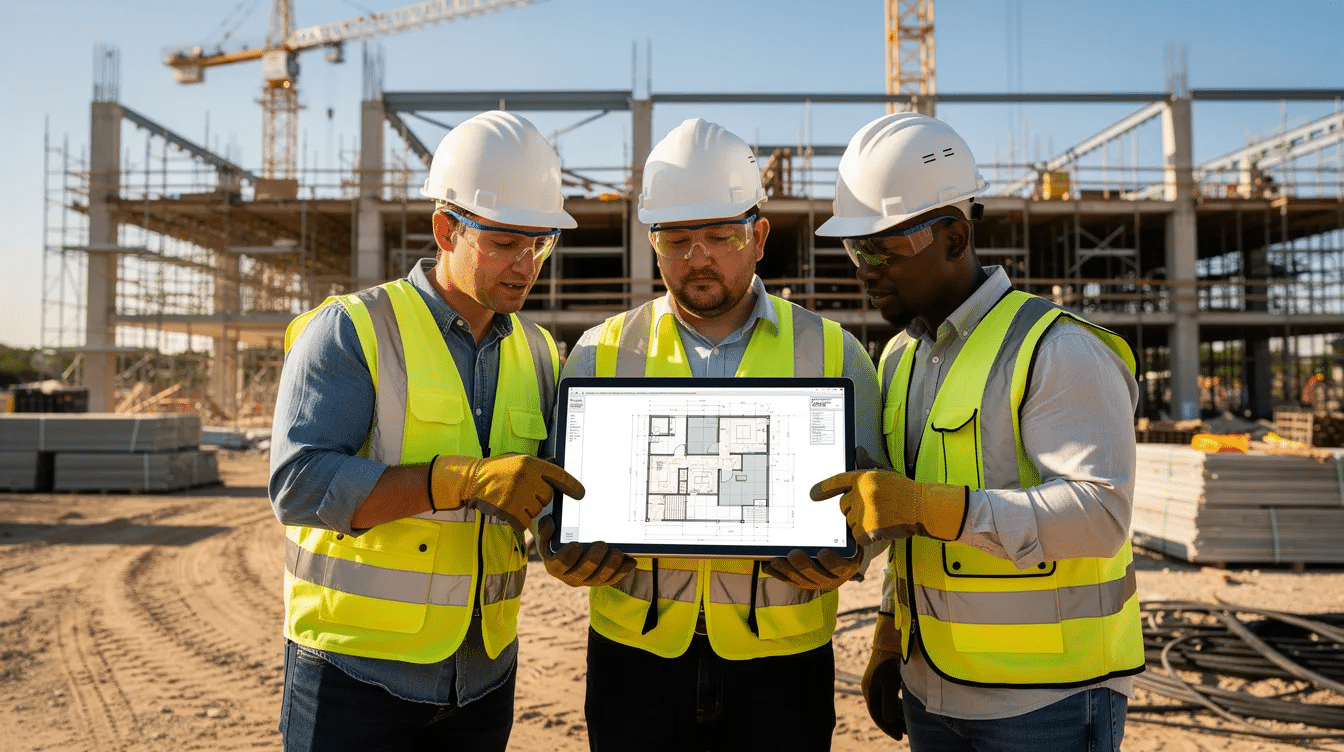
The survey data connects directly to real AI applications on construction projects. This isn’t future speculation—AI in construction is already delivering practical results.
| Use Case | % of AI Users |
|---|---|
| Site operations and monitoring | 46% |
| Planning and design | 46% |
| Estimation, procurement, supply chain | 41% |
Real-world examples of construction AI tools:
AI technologies are being utilized in construction to analyze contracts, highlight risks, and automate the creation of inspection reports from site photos, thereby streamlining workflows. AI-driven monitoring systems support risk identification by detecting errors as they happen on-site, and computer vision analyzes live video feeds to detect unsafe behaviors and flag patterns of minor incidents or “near misses,” improving safety outcomes and supporting decision-making.
Non-technical uses also matter:
The integration of AI into in-house construction workflows and systems enables the automation of repetitive tasks, improves efficiency, streamlines data entry, and enhances communication. AI solutions are being developed to enhance efficiency, safety, and innovation in the construction industry. But human judgment still governs critical decisions—interpreting RFIs, validating plan conflicts, and making final calls. AI functions as an assistant rather than a replacement.
According to the DEWALT survey, the biggest barrier to leveraging AI in construction isn’t belief—it’s training. Most construction professionals are trying to learn AI on their own without construction-specific guidance. Lessons learned from early adopters of AI in construction highlight valuable insights and practical takeaways, helping others understand and implement similar technology more effectively.
A primary barrier to effective AI training is the lack of internal expertise; many professionals lack the digital literacy needed to manage data-driven AI systems. The survey confirms this:
This is a problem for the construction industry because non-construction AI courses don’t address construction documents, Procore or similar software, estimating workflows, procurement cycles, or OSHA safety requirements. Generic tech training ignores construction environments entirely. AI can identify specific skill gaps within a team and suggest targeted training to improve efficiency and safety, addressing limitations of informal training.
Artificial intelligence is transforming construction training by moving away from traditional classroom methods toward immersive, data-driven learning. Training programs in AI for construction often include modules on implementing AI solutions, using no-code tools, and understanding industry-specific AI regulations. ABC and DEWALT’s partnership offers AI education grounded in real-world construction management and field operations rather than abstract tech theory.
Hawaii’s construction environment creates unique demands that amplify AI’s value. Island logistics, high shipping and material costs, long lead times, and small multi-hat teams on jobsites all create friction that AI can reduce.
How AI addresses Hawaii’s logistics challenges:
Inter-island scheduling complexity compounds everything. Coordinating trades and fleet management across Oahu, Maui, Hawaii Island, and Kauai requires optimizing crew rotations, barge schedules, and equipment deployment. AI scheduling tools handle this resource allocation more efficiently than manual methods.
High-value Hawaii sectors for AI-fluent contractors:
Proper training enables accurate use of AI for cost estimation and material forecasting, potentially reducing engineering hours by 30% and project costs by up to 20%. AI’s skilled use in project management can boost productivity by as much as 50%.
Because Hawaii’s cost base and logistical constraints exceed those of most mainland markets, even modest gains from construction AI—3-5% improvement in material efficiency or fewer change orders—can yield outsized ROI for local firms.
DEWALT’s collaboration with ABC at the national level represents a focused effort to translate AI into practical tools for the construction industry, including Hawaii’s merit shop contractors.
The DEWALT-ABC initiative includes:
Completing these programs can support career advancement by equipping participants with in-demand AI and automation skills and by providing valuable certifications that validate their expertise for employers and enhance their professional credentials.
AI and automation skills are projected to be among the most sought-after qualifications by employers in the construction industry by 2025. Courses on AI in construction typically cover practical applications such as project planning, cost estimation, safety management, and decision making.
ABC Hawaii is aligning its local training plans with these initiatives so that contractors in Honolulu, Hilo, Kahului, Lihue, and beyond can plug into national AI resources without having to build curriculum from scratch.
ABC Hawaii serves as a trade association and workforce development partner focused on merit shop contractors and suppliers across the islands. The chapter is now adding AI readiness into its broader craft and management education mission.
Current ABC Hawaii training programs:
Exposure to fundamental AI concepts can be woven into classroom and lab sessions over time. AI applications in construction include simulation-based training and immersive technologies (VR/AR), which facilitate personalized learning and safety enhancement. AI-driven Virtual Reality (VR) and Augmented Reality (AR) simulations provide immersive, risk-free environments in which workers can practice dangerous tasks before reaching the site.
Training in a simulated environment helps workers recognize and respond to hazards, reducing accidents. Virtual Reality (VR) allows workers to practice high-risk tasks without physical danger. AI powers detailed simulations that replicate real-world site challenges in a risk-free environment.
ABC Hawaii’s safety and OSHA training programs can introduce AI-powered safety monitoring tools, such as computer-vision-based PPE detection or data-driven incident analysis. Platforms automate tracking of safety certifications and OSHA compliance, ensuring workers are up to date on required training.
AI captures the legacy knowledge of retiring supervisors, allowing new workers to access decades of expertise—critical in Hawaii’s tight labor market. AI helps construction firms manage the transition from manual labor to smart talent roles.
ABC Hawaii will help members translate national DEWALT–ABC AI content into Hawaii-specific workflows, including inter-island fleet management, remote project oversight, and coordination on military and hospitality projects. The chapter provides a low-debt pathway into the trades for working-age adults while equipping contractors, project managers, estimators, and field leaders with up-to-date skills.
This 90-day roadmap moves from theory to practice on a single AI use case—suitable even for absolute beginners in construction AI.
Select a simple, measurable application that touches real project outcomes:
AI can identify specific skill gaps within a team and suggest targeted training to improve efficiency and safety. Start with one focused application rather than trying to transform everything at once.
Form a small cross-functional team—perhaps a project manager, estimator, and field superintendent. Define success metrics:
Pick a specific project in Honolulu, Kapolei, Kahului, or Kona to test. Personalized and immersive training reduces the time required for new workers to become productive on-site. AI analyzes individual performance to customize training content, and can automatically assign targeted video tutorials or practice modules if a worker consistently fails to follow safety protocols or struggles with a specific technique.
Enroll at least one team member in the DEWALT AI Toolbox Takeaways webinar series. Connect with ABC Hawaii staff to identify upcoming sessions, workshops, or modules relevant to your chosen use case.
AI-enhanced training can lead to improved safety, productivity, and cost management in construction. AI-driven automation and robotics tasks are included in curricula to teach workers how to operate or collaborate with robotic systems.
The goal is not to overhaul your entire company overnight but to build internal AI fluency through small, well-scoped pilots that can later expand across more construction projects and islands.

Most current AI tools relevant to construction management are no-code or low-code, designed for project managers, estimators, safety directors, and field leaders rather than software engineers. Basic computer literacy and familiarity with your existing project management or estimating systems are usually sufficient to begin, especially when supported by structured training like the DEWALT AI Toolbox Takeaways series. More advanced options, such as Python APIs, exist but are not required for early pilots or absolute beginners.
AI is often most valuable for small teams because it automates repetitive data analysis and documentation tasks, freeing limited staff to focus on coordination, client communication, and quality control. Examples relevant to smaller projects include using AI to draft daily report summaries, track procurement risks for a single resort renovation, or optimize schedules when crews travel between Oahu and Maui. The cost of a delayed shipment or rework is proportionally higher on small teams, meaning AI-driven improvements create an outsized impact. AI can significantly enhance project management in construction by automating repetitive tasks, thereby improving efficiency and productivity.
AI training does not replace hands-on craft training or OSHA compliance education but complements them by showing workers how to use digital tools that support safety, quality, and productivity. AI topics can be integrated into existing modules—using AI for toolbox talk preparation, near-miss analysis, or digital review of installation instructions. ABC Hawaii can progressively layer AI concepts into apprenticeship, craft, and management courses rather than creating a separate curriculum. Enhanced jobsite safety results from training workers to use AI, shifting safety from reactive to proactive—some firms report incident reductions of 40% to 50%. AI-powered monitoring systems can identify hazards, reduce on-site risks, and ensure regulatory compliance.
Data security and confidentiality are legitimate concerns, especially when uploading contracts, drawings, or cost data into AI systems. Contractors should vet AI vendors for clear data-handling policies, onshore data storage where possible, and options for private or enterprise-grade environments that protect proprietary information. Part of AI training—through ABC and DEWALT resources—should include understanding privacy settings, user permissions, and best practices for handling sensitive project data. The integration of AI in construction project management can help reduce project delays and minimize duplication of work, ultimately improving safety outcomes.
Designate an internal “AI champion” or a small committee to track developments in construction AI and share quarterly updates. Participate in ABC Hawaii and national ABC education offerings, including the DEWALT AI Toolbox Takeaways webinars and future AI-focused workshops. Build AI learning into annual training plans and budgets, treating it like safety updates, code changes, or new OSHA requirements—an ongoing professional development priority rather than a one-time initiative. AI requires clean, structured data to be effective, which is often difficult to obtain in the traditionally fragmented construction industry. Effective AI requires large amounts of high-quality data, and AI technology implementation requires significant investment in training, software, and hardware. AI-enriched programs measure compliance with safety standards and track progress, helping organizations demonstrate training effectiveness. High initial investment in both AI hardware and software, as well as necessary training programs, can be prohibitively expensive, but structured approaches through ABC reduce this barrier. AI applications in construction can significantly enhance project planning, cost estimation, safety management, and quality control, leading to improved performance and reduced project delays.
The firms building AI fluency now will lead Hawaii’s next decade of construction. Start your 90-day pilot this quarter, get a team member enrolled in the DEWALT AI Toolbox Takeaways webinar series, and contact ABC Hawaii to explore how AI training integrates with your workforce development strategy. This is a perfect opportunity to position your company ahead of the curve on federal, military, and hospitality projects across the islands.