
You know the feeling of a construction site. The smell of fresh-cut wood and the sight of a structure taking shape are familiar. But what if you could walk through that structure before the first nail is hammered?
This is no longer science fiction; it’s the practical application of virtual reality in construction today. You’re about to see how this reality technology is moving from gaming consoles to your job site. It is changing everything from how you design a construction project to how you keep your team safe.
This isn’t a far-off fantasy for construction companies. It’s a fundamental tool that construction businesses of all sizes are currently using. This represents a shift in how construction projects are conducted, and the use of virtual reality in construction is at the center of it all.
ABC Central Texas offers safety classes for our members online and in person. We offer OSHA training through a partnership with UT Arlington with classes held in our office. We also hold monthly CPR classes.
For decades, blueprints and 3D renderings were the best we had. They did the job, but they always left something to the imagination. Explaining the scale and feel of a space from a flat piece of paper or a screen can be challenging, which can lead to misunderstandings with clients and your team.
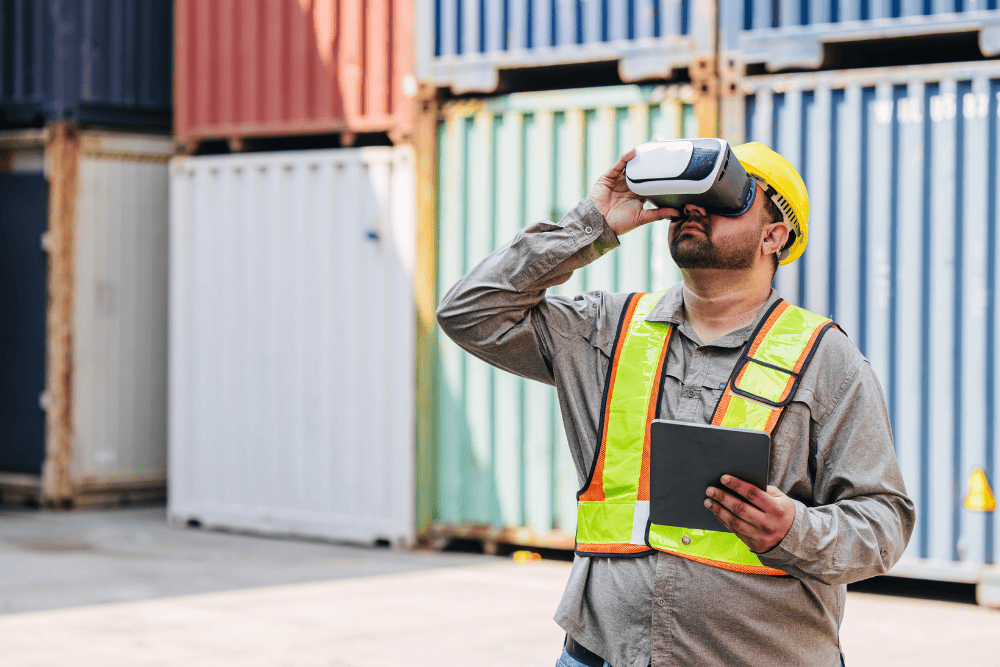
Now, you can put on a VR headset and stand inside the building you’re designing. Architects and designers use this to get the details perfect, seeing how light falls in a room or if a hallway feels too narrow. This ability to perceive and interact with spatial relationships in an entirely virtual environment is a significant leap forward.
This changes the game for pitching projects. Instead of just showing clients drawings, you give them a tour. They can see the view from their future office window or walk through their new kitchen, exploring various design options in real time. This immediate, immersive experience helps them understand the vision and builds a powerful emotional connection to the project before it’s built.
This process significantly improves the Building Information Modeling (BIM) process. A VR project enables stakeholders to step inside the BIM model, providing a much deeper understanding than a 2D screen could ever offer. As a result, architecture firms are utilizing VR to obtain faster approvals from clients, as everyone is on the same page.
This level of clarity helps reduce material waste. When clients and project teams can agree on every detail in a virtual space, the likelihood of last-minute changes that require discarding already purchased materials drops sharply. This enhanced client communication ensures the final building design meets expectations perfectly, saving both time and resources.
You do not need a massive budget to get started with these VR solutions. While high-end headsets exist, many VR experiences can be accessed on a desktop or with simple accessories for a smartphone. The point is to make the virtual space accessible so that everyone, from the project manager to the client, can explore it, eliminating guesswork and resulting in much smoother projects.
Construction sites are inherently dangerous places. Even with the best safety protocols, accidents can still occur. The Occupational Safety and Health Administration (OSHA) reports thousands of fatal work injuries in construction each year, a statistic the building industry constantly works to lower.
Virtual reality gives you the power to conduct construction safety training in a completely safe, controlled setting. A new employee can learn to operate a forklift, crane, or excavator inside a simulation. They can make mistakes, tip the machine over, or hit a virtual wall without causing a single injury or a dollar of damage, which is a core benefit of deploying VR for training workers.
This VR training allows them to get the hands-on experience they need to build confidence before ever stepping onto the actual equipment. The immersive nature of the technology helps with muscle memory and reaction times. This is incredibly valuable for more than just new hires; these training programs can also be used to upskill your existing construction workers.
You can use VR to run emergency drills or simulate rare but hazardous situations, such as a structural collapse or equipment malfunction. It helps workers develop reflexes for the proper safety procedures, so they can react correctly if the real thing ever happens. Training safety in fully virtual environments is one of the most compelling use cases for immersive technologies in the construction industry.
This type of training also solves logistical problems. Consider training workers in remote areas or those with a tight schedule. Instead of flying them out for weeks of off-site training, you can send VR equipment to them, providing immersive experiences at the exact location where they are needed.
This saves a significant amount of money and time, allowing you to upskill local labor for specialized jobs without disrupting their lives. VR technology enables construction companies to deliver consistent, high-quality training across all their projects, regardless of their geographical location. It’s a more innovative, safer way to prepare your workforce for the demands of the modern job site.
| Feature | Traditional Training | VR Training |
|---|---|---|
| Environment | On-site or classroom-based. | Controlled, safe virtual environments. |
| Risk Exposure | Potential for real-world accidents and injuries. | Zero physical risk to trainees or equipment. |
| Cost | High costs for equipment, trainers, and site shutdowns. | Lower long-term cost after initial hardware investment. |
| Knowledge Retention | Relies on theoretical learning and limited practice. | Significantly higher retention due to hands-on, immersive nature. |
| Accessibility | Limited by physical location and equipment availability. | Highly accessible and can be deployed anywhere. |
| Scenario Replication | Difficult and dangerous to replicate high-risk events. | Easily simulates rare and hazardous real-life situations. |
Join ABC Hawaii
Our mission is to safeguard and advance the Free Enterprise system by representing the interests of merit shop contractors, employees, and businesses in policymaking while delivering comprehensive training and education. Join us in shaping a strong, competitive construction environment that supports growth and excellence across Hawaii.
Rework is one of the biggest budget killers in the construction industry. A simple miscalculation can lead to tearing out freshly poured concrete or moving walls that are already framed. These are expensive, time-consuming errors that frustrate both your crew and your client.
Virtual reality technology gives you a chance to catch these mistakes when they’re still just pixels on a screen. By creating virtual models of the project, you can spot clashes between different systems before construction begins. You may notice that an HVAC duct is located directly where a central plumbing line is intended to run.
Fixing that clash in a digital model costs nothing. Fixing it in the field could set you back thousands of dollars and delay the project by weeks. Identifying potential issues early on is crucial for effective project management and helps prevent costly disruptions.
VR construction models allow for meticulous project planning. Teams can conduct virtual walkthroughs to review every detail, from the placement of electrical outlets to the clearance for mechanical systems. This proactive approach is key to reducing errors and ensuring the final build aligns with the initial plans.
The benefits extend to the real environment of the construction site through augmented reality, or AR. Team members can use tablets or AR-enabled glasses to overlay digital plans onto the physical environment, allowing them to visualize the project’s progress in real-time. This AR VR combination ensures that components are installed in the exact location specified in the model, dramatically improving accuracy.
This reality technology can also help with managing labor costs. Instead of needing multiple people on site for initial assessments, a site manager can use a virtual representation to make calculations. It allows a lot of the initial planning to happen remotely, saving time and money on sending crews to the field before they’re ready to start actual work.
How many construction projects finish exactly on schedule? Delays are common, and even a small change can have a ripple effect on the entire timeline. When a client requests a change or an unexpected site condition arises, you must adjust quickly.
Dynamic 3D models in a VR experience let management see these changes instantly. They can visualize the new conditions and adjust the plan immediately. This agility helps keep the project moving forward, rather than getting stuck waiting for new drawings or revised plans; you can identify problems before they become full-blown crises.
This technology also dramatically improves the customer experience. Construction can be a long and stressful process for clients. Providing them with the ability to conduct virtual walkthroughs at various stages of the project keeps them involved and excited, thereby improving collaboration.
They can see the progress for themselves and feel confident that their vision is taking shape. This transparency is invaluable for building trust and maintaining a positive relationship throughout the project. When team members from different disciplines can meet inside a virtual environment, it streamlines communication and speeds up decision-making, which in turn improves efficiency.
When the final product matches what the client experienced in VR, satisfaction soars. It removes the element of surprise that often accompanies traditional methods of communication, such as reviewing 2D drawings. This transparency and engagement turn clients into happy advocates for your construction business, positively impacting project outcomes.
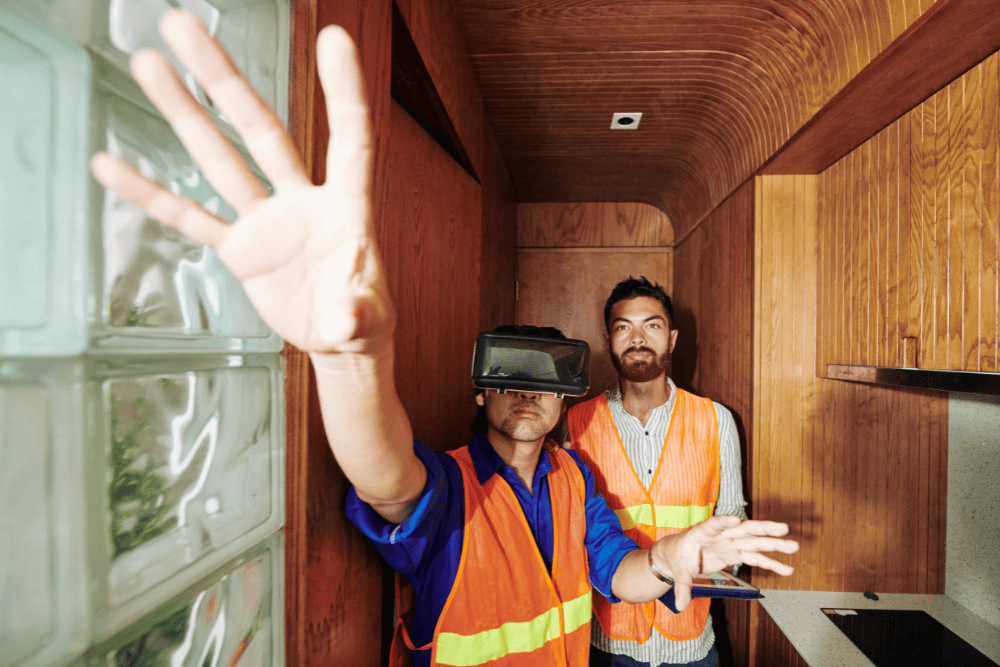
While virtual reality is a major player, it is part of a larger technology revolution in construction. Other smart construction technologies are working alongside VR and mixed reality to make construction sites more efficient and safer. These tools help a construction business stay competitive.
Smart helmets are a great example. They look like regular hard hats but are packed with technology. Some have built-in augmented reality visors that can display blueprints directly in a worker’s line of sight, while others use sensors to detect falls or send alerts about dangerous conditions, boosting construction safety.
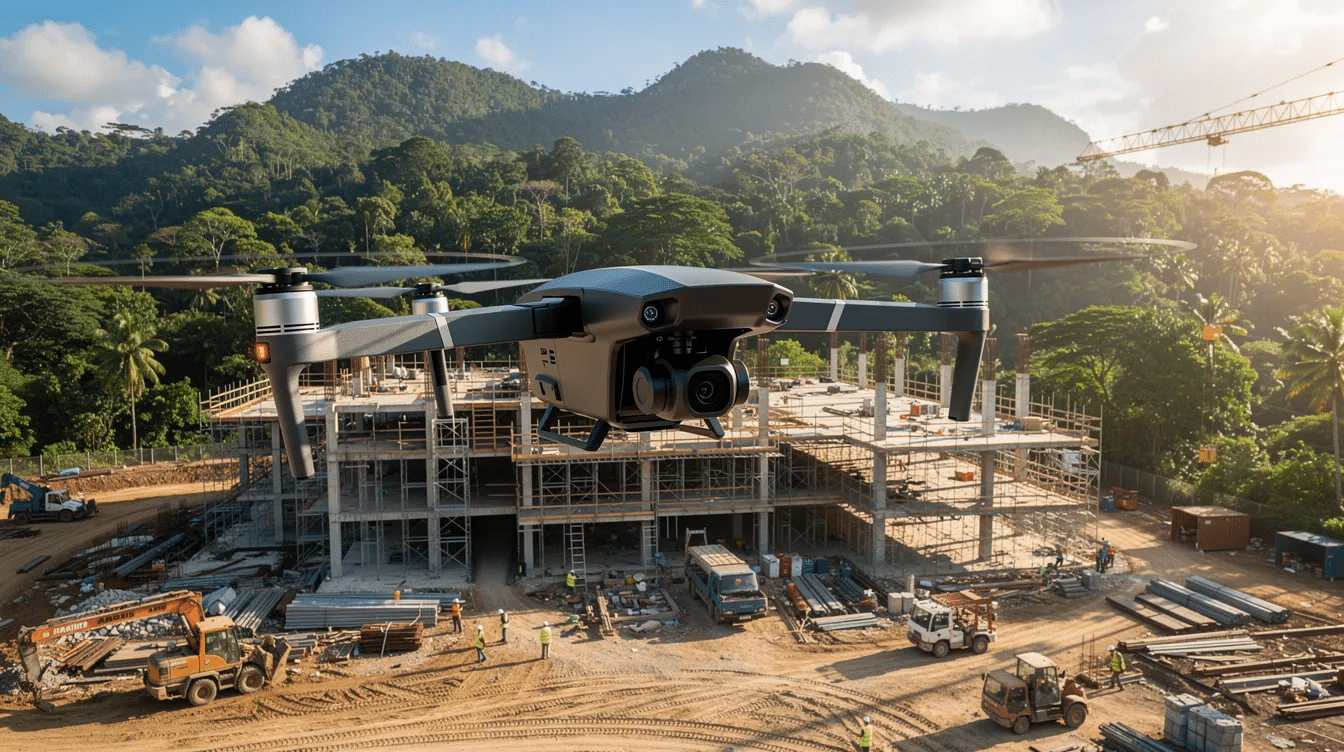
Drones are another game-changer, used for everything from initial site surveys to monitoring progress. They can quickly capture high-resolution imagery and real-time data, which can then be used to create accurate 3D models for VR walkthroughs. This integration of data collection and visualization streamlines many construction activities.
Estimating software has also come a long way. These tools, often enhanced with artificial intelligence, help contractors create accurate bids quickly. They can pull data, manage documents, and track budgets in real time, and this accuracy at the beginning of a project helps prevent cost overruns later on.
Even the way payments are handled is changing, with mobile applications making transactions easier. Modern credit card processors and point-of-sale systems are designed for construction companies. They make it easier for clients to make payments and for you to manage the financial side of your business smoothly. Together, these technologies are building a new foundation for the industry.
Thinking about virtual reality in construction as just a tool for video games is a thing of the past. It has become a practical and powerful asset for building projects better, faster, and with fewer risks. From designing and pitching projects to training your team in a safe environment, the benefits are clear and tangible.
This is not some future concept; it’s a real-world solution that is saving companies money and preventing costly mistakes right now. By bringing a project to life before you break ground, you can align your construction teams, excite your clients, and spot problems before they happen. It represents a fundamental shift in how we approach building things.
The continued growth of virtual reality in construction is not a question of if, but when it will become a standard tool on every job site. Adopting this technology helps construction companies improve efficiency, enhance safety, and deliver superior results. The future of the building industry is being built in virtual environments today.